

R&D capability
Content Introduction
Zhang Zhiwei, graduated from Tianjin University with a Master's degree and is a mid-level engineer with 5 years of simulation work experience. He is well-versed in low-frequency electric and magnetic field simulation modeling and has expertise in fluid-structure interaction thermal simulation. Zhang specializes in structural static strength, modal analysis, transient dynamics, and random vibration analysis. He has participated in the design and validation of fire protection systems for the AG600 amphibious aircraft in the aviation industry and the design and development of smoke detection systems for the cargo hold of the CR929 aircraft.
Zhang Xiong, graduated from Hebei University of Technology with a Master's degree and is a junior engineer with 3 years of simulation work experience. He is proficient in magnetic and electric field simulation and analysis for electrical equipment and specializes in loss and temperature rise simulation calculations for structural components. He has participated in design and development projects such as the Key Electromagnetic Characteristics and Loss Simulation Research of Transformers" and Key Technologies for Vibration Damping and Noise Reduction of Transformers and Their Engineering Applications."
As a critical component of ultra-high voltage DC transmission projects, dry-type smoothing reactors play an indispensable role in limiting overcurrent and overvoltage during inverter-side voltage collapses, as well as in suppressing ripples. With the increase in the number of encapsulated winding layers in dry-type smoothing reactors, the impact of harmonic currents on loss calculations becomes increasingly significant, complicating the monitoring of temperature rise hotspots.
By utilizing CFD (Computational Fluid Dynamics) fluid-thermal coupling simulation technology and integrating electromagnetic loss density into CFD software, one can analyze the thermal flow field distribution under the combined effects of high-temperature radiation and natural convection heat transfer. This approach provides a theoretical foundation and reference for the online temperature monitoring and fault diagnosis of reactors.

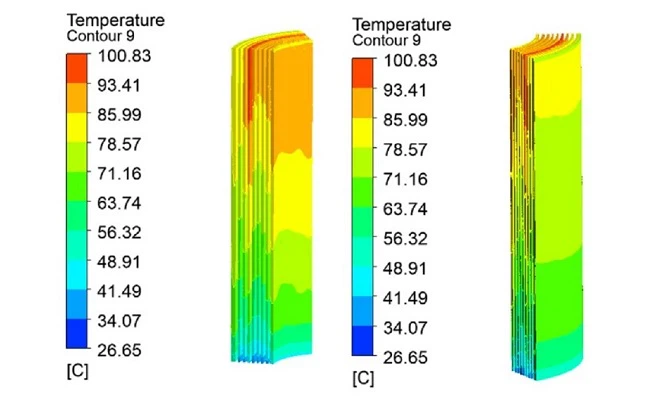
Large dry-type air-core reactors are extensively utilized in ultra-high voltage power systems due to their high linearity, low losses, stable parameters, and low resistance. As the voltage levels and sizes of air-core reactors continue to increase, the intense magnetic fields they generate become significant concerns. These magnetic fields can induce eddy currents and circulating currents in nearby electrical equipment or structural components, leading to increased losses, elevated temperatures, and malfunctioning protection systems.
Consequently, it is imperative to study the spatial magnetic field distribution of air-core reactors and provide effective magnetic field shielding recommendations to mitigate these issues.


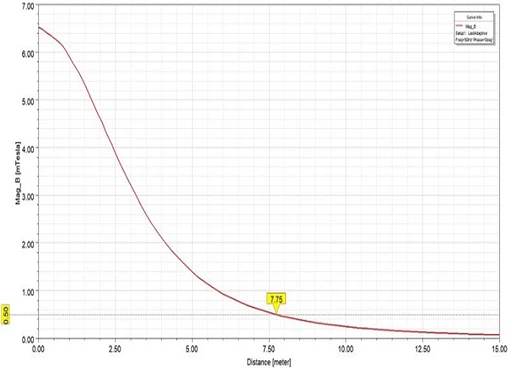
Recommended magnetic clearance
In ultra-high voltage (UHV) systems, dry-type air-core reactors can have uneven potential distribution, leading to corona discharge problems. By using equalizing devices, the electric field can be made more uniform, thereby reducing corona discharge and meeting project requirements. Theoretical calculations for precise electric fields are complex, but numerical simulations make studying these issues easier and clearer. By using finite element analysis tools to simulate the electric field in reactor structures, engineering design problems can be effectively solved, offering useful reference data for the development and maintenance of UHV reactors.


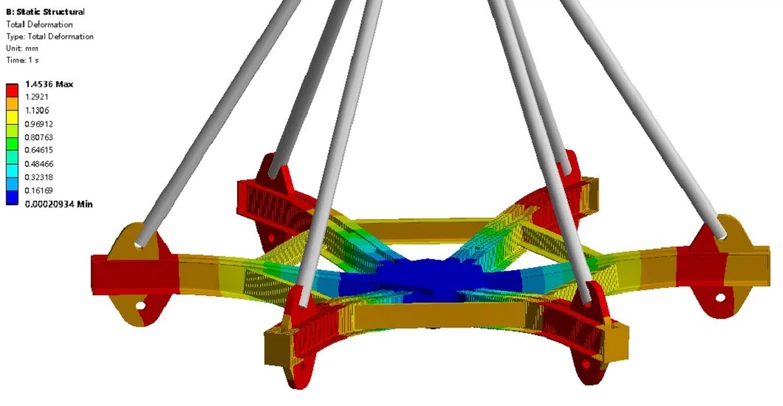
Dry-type smoothing reactors for UHV systems are tall, heavy, and difficult to install. Using finite element analysis software, we can calculate the strength and stiffness during transportation and hoisting. This helps design lifting equipment and choose stay wires for the reactors.

Dry-type air-core reactors are key components in substation DC transmission projects. They are heavy, large, and have a high center of gravity. With natural frequencies between 1Hz and 10Hz, they are susceptible to resonance during earthquakes. Using finite element analysis software, the deformation and stress of the reactor's support insulators and fixing bolts are analyzed under combined loads (seismic, gravity, wind). This helps provide design references for the reactor support system.

Modal Analysis of Reactor Support System
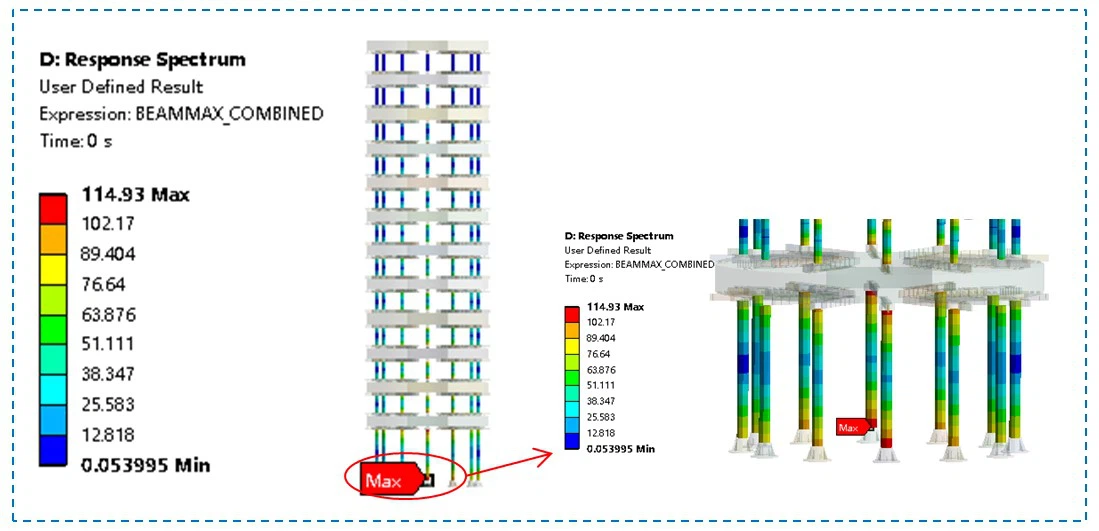
Stress Analysis of Support Insulators